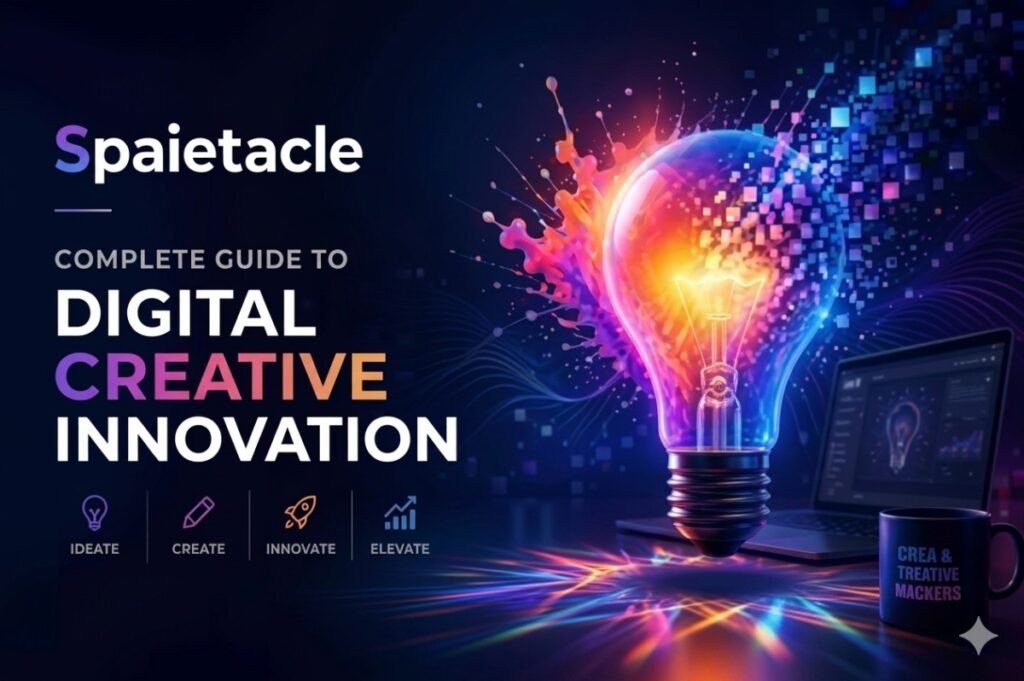

Discover the Spaietacle aesthetic, a groundbreaking fusion of space and spectacle. Explore how this immersive trend is transforming art, architecture, and tech.
The Dawn of the Spaietacle: Defining the 2026 Aesthetic
Something fundamental has shifted in how we experience art, entertainment, and designed environments. Spaietacle — the deliberate fusion of space and spectacle — has emerged as the defining aesthetic framework of 2026, reshaping everything from festival installations to retail architecture and wellness retreats.
This isn’t a minor design trend. It’s a rethinking of what an environment is for.
Where traditional spectacle kept audiences at arm’s length — watching, passive, separate — the spaietacle dissolves that boundary entirely. According to Blessify Daily, the concept captures a cultural hunger for experiences that don’t just impress but envelop, turning the surrounding space itself into a medium of expression.
Central to this is what practitioners call the choreography of environments: the intentional sequencing of sensory inputs — light, sound, texture, movement, scale — across a physical space so that the journey through it becomes the performance. The room isn’t a backdrop. The room is the show.
Environments that choreograph attention are no longer exceptional — they’re expected.
Why now? Audiences fatigued by screens and flattened digital experiences are actively seeking physical depth. As Bilium News notes, the demand reflects a broader cultural recalibration toward presence over consumption.
To understand where the term itself comes from — and why that etymology matters — it helps to trace the word’s origins.
Etymology and Origin: From Passive Viewing to Active Presence
To understand why spaietacle resonates so powerfully in 2026, it helps to trace where the word actually comes from. The term is a deliberate portmanteau of “space” — meaning the designed environment itself — and “spectacle” — the theatrical, visual, or performative event unfolding within it. That fusion isn’t just linguistic cleverness. It encodes a philosophy: that the container and the content are inseparable.
The Ghost of the 20th-Century Spectacle
Guy Debord’s 1967 concept of the Society of the Spectacle described a world where lived experience had been replaced by its representation — passive audiences consuming images from a distance. That model dominated entertainment for decades. Cinema, television, stadium concerts — all brilliant, all fundamentally external. You watched. The experience happened to you.
The 21st century has been a slow, steady rejection of that relationship.
The Cultural Demand for Presence
What’s driving the shift is something deeper than technology. Audiences increasingly want to be inside the story, not seated in front of it. According to Hellohuda’s analysis of spaietacle, the concept reflects a broader cultural hunger for lived, embodied experiences over static visual consumption.
Spaietacle isn’t about making the spectacle bigger — it’s about making the audience’s presence the spectacle itself.
This distinction is subtle but transformative. And it’s exactly what separates spaietacle from everything that came before — a difference worth examining much more closely.
Spaietacle vs. Traditional Spectacle: The Critical Differences
Understanding what makes spaietacle genuinely new requires holding it up against what came before. Traditional spectacle — think stadium concerts, theatrical productions, or public installations — operates on a fundamental assumption: the audience is separate from the experience. There’s a clear boundary between performer and observer, between art object and person perceiving it.
Spaietacle collapses that boundary entirely.
External Event vs. Internal Journey
A traditional spectacle is something you watch. A spaietacle is something you’re inside. This isn’t just a poetic distinction — it’s structural. In conventional immersive art or entertainment, even the most elaborate productions typically maintain what designers call “the frame”: a defined edge where the experience lives and your ordinary reality resumes. Think of a cinema screen, a stage proscenium, or a museum rope line.
In a spaietacle, the environment itself is the frame. Walls, floors, sound fields, temperature, and even crowd density become compositional elements. There’s no safe vantage point outside the experience, because the experience is the space you occupy.
Static Design vs. Reactive Intelligence
Perhaps the most consequential difference is what happens after the experience begins. Traditional spectacles are largely fixed — a choreographed sequence that unfolds the same way regardless of who’s watching. Spaietacle, by contrast, is dynamic by design.
AI-driven systems monitor crowd movement, emotional response signals, and real-time environmental data to adjust lighting, sound, and spatial elements on the fly. As Bilium News notes, this responsiveness transforms passive audiences into unwitting co-creators of the experience itself.
The spaietacle doesn’t perform for you — it performs with you. That distinction matters enormously, and it’s only possible because of the technology infrastructure now coming into maturity — which we’ll examine closely next.
The Tech Stack: Why 2026 is the Tipping Point
Knowing what spaietacle is only tells half the story. The more pressing question is: why now? The answer lies in a rare convergence of technologies that, individually, were impressive — but together, are genuinely transformative.
Enterprise AI as the Creative Engine
The foundation of modern spaietacle environments is artificial intelligence, and its reach has grown dramatically. Enterprise AI adoption has surged to 88% across major industries, meaning the tools that once required dedicated research labs are now embedded in everyday production pipelines. Designers, venues, and experience architects can deploy AI to generate adaptive content, analyze audience behavior in real time, and adjust environmental variables — lighting, sound, spatial patterning — without a single manual intervention. Spaietacle isn’t just designed; it’s continuously authored by intelligent systems responding to the room.
Spatial Computing as the Hardware Backbone
None of this works without the right physical infrastructure. Spatial computing — the category of hardware that processes and overlays digital information onto three-dimensional physical space — has matured considerably. Sensor arrays, depth cameras, and edge-computing nodes now operate at speeds that eliminate the latency that previously made immersive environments feel glitchy or disconnected. Every surface, from a public display in a transit hub to a curved museum wall, can become a responsive canvas. The hardware is no longer the bottleneck.
Smart Connectivity and Environmental Choreography
Perhaps the most underappreciated enabler is smart connectivity. Low-latency networks allow every element of a spaietacle environment to communicate simultaneously — speakers sync with visuals, haptic elements respond to movement, and environmental conditions shift in coordinated waves. What typically happens is a kind of real-time choreography that feels organic rather than programmed.
This technological convergence sets up a fascinating downstream effect: when the environment itself becomes this responsive, what you wear — and how it interacts with that environment — becomes a critical new frontier. That’s exactly where eyewear enters the conversation.
Comparison: Traditional Content vs Spaietacle Approach
| Aspect | Traditional Content | Spaietacle Approach |
|---|---|---|
| Focus | Information delivery | Experience + impact |
| Engagement | Moderate | High |
| Visual Storytelling | Limited | Strong |
| Memorability | Low | High |
| Audience Interaction | Passive | Active |
| Emotional Connection | Weak | Strong |
| Content Differentiation | Low | High |
| Brand Recall | Average | Excellent |
Spaietacle in Fashion: The Rise of Spatial Eyewear
Eyewear has always sat at the intersection of function and identity — but in 2026, that intersection has become a launchpad. To understand what is spaietacle at its most personal, look no further than the latest generation of spatial eyewear redefining how individuals see and interact with the world around them.
The shift from vision correction to identity expression is now complete. Frames are no longer passive accessories; they’re statements of how someone chooses to experience reality. Smart eyewear now carries AR overlays, environmental sensors, and real-time connectivity — layering personalized data directly onto a wearer’s field of vision.
Spatial eyewear doesn’t just correct what you see — it curates it, making every environment a personally choreographed experience.
What makes this genuinely “spaietacle” is the individual perception shift. A plaza looks different through adaptive AR lenses than through naked eyes. Ambient data — temperature, sound levels, social context — merges seamlessly with physical surroundings.
These wearable spaietacles set the stage perfectly for the immersive environments you’ll explore in the next section.
Step-by-Step Spaietacle Framework
| Step | Action | Purpose |
|---|---|---|
| 1 | Identify audience needs | Ensure relevance |
| 2 | Define core message | Maintain clarity |
| 3 | Add visual and emotional hooks | Capture attention |
| 4 | Structure content clearly | Improve readability |
| 5 | Optimize for engagement | Increase interaction |
Real-World Examples: Spaietacles You Can Experience Today
Theory only takes you so far. The real proof of spaietacle’s momentum lives in spaces you can actually walk into — or log into — right now.
Urban Plazas: Cities as Living Canvases
Public squares and city centers are becoming some of the most compelling spaietacle environments in 2026. Interactive light-and-sound installations now respond to foot traffic, weather data, and even crowd noise in real time. Spatial computing 2026 deployments in cities like Chicago and Amsterdam are transforming underused plazas into destinations — where the architecture itself becomes part of the experience. A common pattern is that attendance at these activations spikes on weekends, driving measurable increases in local retail foot traffic.
A standout example: the art installations at Coachella 2026 demonstrate how large-scale, sensor-driven environments can hold tens of thousands of people in a shared spatial narrative simultaneously.
Museums: Exhibits That Move With You
Forward-thinking cultural institutions are redesigning exhibits around visitor behavior. Motion-tracking cameras and spatial audio systems create displays that literally shift as people mmove through a gallery. Dwell time increases dramatically when visitors feel like the exhibit is responding to them — because it is.
Digital Worlds: The Choreography of Space
In VR environments, spaietacle principles have introduced what designers call the choreography of space — the deliberate sequencing of virtual rooms, sightlines, and audio cues to guide emotional response. This isn’t passive consumption; it’s participatory architecture.
Spaietacle, at its most powerful, makes the audience forget they’re experiencing a design at all. These real-world applications are only the beginning — raising the question of what spaietacle could look like when it becomes the default, not the exception.
The Future of Immersive Content: Beyond 2026
Spaietacle isn’t a trend with an expiration date — it’s becoming the baseline expectation for how people experience public spaces, culture, and commerce. From augmented reality fashion runways to sprawling urban light installations, the format has proven one undeniable truth: audiences no longer want to observe. They want to inhabit.
The long-term ripple effects extend into architecture and urban planning. Designers are already rethinking plazas, transit hubs, and retail corridors as programmable sensory canvases rather than static structures.
Spaietacle is the defining immersive experience of 2026 because it transforms presence itself into participation. As the line between physical and digital space continues to dissolve, the experiences built at that boundary will shape culture for years ahead. Step in.

Key Takeaways
- Environments that choreograph attention are no longer exceptional — they’re expected.
- Spaietacle isn’t about making the spectacle bigger — it’s about making the audience’s presence the spectacle itself.
- the audience is separate from the experience
- the environment itself is the frame
- The spaietacle doesn’t perform for you — it performs with you.
Frequently Asked Questions (FAQ)
What does spaietacle mean?
Spaietacle refers to a strategic approach to creating visually engaging and impactful content that enhances audience experience.
Why is spaietacle important?
It helps improve engagement, retention, and overall content performance in competitive digital environments.
How can I apply spaietacle in my content?
Focus on storytelling, visual design, and clear structure while keeping your audience’s needs in mind.
Is spaietacle only for digital marketing?
No, it can be applied to branding, presentations, and even offline experiences.
Can beginners use spaietacle strategies?
Yes. Beginners can start with simple techniques like better visuals, clear formatting, and audience-focused storytelling to improve content impact.